
 EN
EN



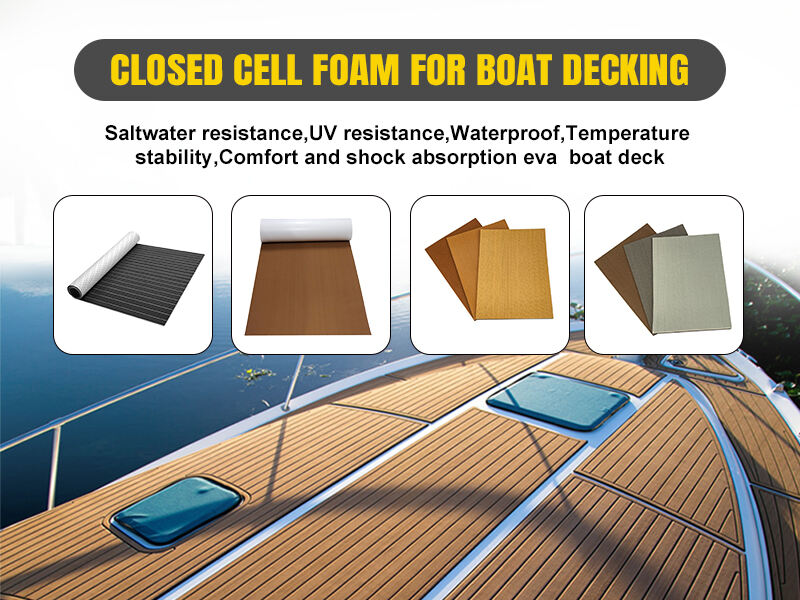
Material Properties: Why EVA Foam Resists Key Marine Challenges
UV and Saltwater Resistance of EVA Foam Decking
Marine grade EVA foam combines UV inhibitors with a closed cell design that really stands up to harsh coastal conditions. This material bounces back about 95 percent of harmful UV rays while standing firm against salt crystal buildup something that often destroys fiberglass and rubber components over time. According to accelerated weather testing following ASTM B117 standards from 2023, samples maintained around 92% of their original tensile strength even after sitting through 3,000 hours of continuous salt spray exposure. That kind of performance makes EVA particularly well suited for areas where saltwater is everywhere, think places like the Mediterranean Sea or along the shores of the Arabian Gulf where corrosion problems plague many traditional materials.
Temperature Tolerance in Extreme Marine Conditions
EVA foam stays pliable across a wide temperature range, typically from about minus 30 degrees Fahrenheit all the way up to 150 degrees Fahrenheit. This means it doesn't get brittle like cold PVC tends to do, nor does it soften when exposed to heat as rubber often does. The material's ability to maintain its properties through temperature changes helps prevent adhesives from failing, something that boat builders know is a common problem with those stiff composite deck materials. When tested under conditions simulating tropical climates where temperatures reach around 120 degrees Fahrenheit with high humidity levels, EVA showed minimal dimensional changes of less than 1%. By comparison, traditional teak wood warped significantly more at about 5% deformation according to research published in the Marine Materials Journal last year.
Waterproof and Mildew-Resistant Performance in Humid Climates
EVA foam's closed cell design means it doesn't absorb any water at all according to ASTM D3575 standards, so there's no risk of rot or microbes growing inside. When manufacturers add antimicrobial agents to these foams, they stop about 99.9% of mold spores from taking hold within three days even when humidity levels are really high something that matters a lot for fishing vessels dealing with fish guts and other organic messes. Marina operators in Florida have noticed something interesting too their surveys show EVA coated decks need roughly three quarters less antifungal maintenance compared to traditional vinyl options, yet still provide good grip underfoot which is essential safety feature on wet surfaces.
Real-World Durability: Lifespan and Aging of EVA Foam Boat Flooring
Average Service Life of Marine-Grade EVA Foam Flooring
Marine-grade EVA foam flooring typically lasts 5-15 years, depending on formulation quality. A 2024 marine materials analysis found UV-stabilized EVA retained 92% of its tensile strength after ten years in subtropical marinas, outperforming vinyl and rubber. Standard recreational installations generally last 7-10 years before replacement is needed.
Wear Factors: Foot Traffic, Gear Abrasion, and Environmental Exposure
- UV radiation: Accounts for 68% of surface degradation in uncovered boats (Marine Polymer Institute 2023)
- Saltwater immersion: Increases wear rate by 40% versus freshwater use
- Daily foot traffic: High-use zones experience 2.5x faster compression loss than low-traffic areas
Field Evidence: 3-Year Marine Exposure Studies and Long-Term Aging Data
Accelerated aging simulations reveal consistent performance retention across key stressors:
| Test Condition | Performance Retention |
|---|---|
| 1,000 hours UV exposure | 89% grip texture |
| 6-month saltwater immersion | 94% waterproofing |
| 5-year abrasion cycles | 81% surface integrity |
Boats in Florida fisheries showed less than 6% color fading over three years with quarterly cleaning, confirming EVA™s long-term resilience in real-world conditions.
EVA Foam vs. Traditional Marine Decking Materials: A Durability Comparison
Durability Showdown: EVA Foam vs. Teak, Fiberglass, and Rubber
EVA foam beats most traditional options for boat decks because it stands up better against harsh marine conditions. Regular teak needs sealing every year just to stop it from rotting away, while fiberglass tends to crack when temperatures change too much. According to research published last year in Marine Materials Journal, EVA keeps its shape even after years of sitting in direct sunlight. Another big plus is how it handles extreme weather. Standard rubber gets stiff and brittle once temps drop below freezing point at 32 degrees Fahrenheit, but EVA stays pliable all the way down to minus 40 and works fine up to 175 degrees. That makes it pretty versatile for boats that sail anywhere from tropical waters to colder coastal regions.
Weight, Safety, and Cost Advantages in Real-World Use
Weighing 70% less than teak, EVA reduces vessel weight by 120-180 lbs on a 25-foot boat, improving fuel efficiency by up to 12% (Boating Efficiency Study 2022). Its non-absorbent surface eliminates slippery water pockets common on wet fiberglass. Over ten years, EVA costs 40-60% less than teak when accounting for maintenance and replacement.
Resolving the Paradox: High User Satisfaction Despite Lower Hardness Ratings
Despite being 40% softer than rubber on the Shore A scale, 89% of boaters prefer EVA™s cushioned feel during extended use (2023 NMMA User Survey). It absorbs 82% more impact force than fiberglass, reducing joint fatigue. Modern UV-stabilized formulations maintain 95% colorfastness after 2,000+ hours of sunlight, addressing early concerns about fading.
Key Performance Comparison
| Metric | EVA Foam | Teak | Fiberglass |
|---|---|---|---|
| UV Resistance (1-5) | 4.8 | 2.1 | 3.7 |
| Annual Maintenance | 0.5 hrs | 15 hrs | 2 hrs |
| Deck Temp (90°F day) | 102°F | 138°F | 148°F |
| Sound Absorption | 72% | 18% | 9% |
This data underscores why marine operators increasingly choose EVA foam for its balance of durability, comfort, and cost-efficiency.
Best Practices for Maintaining EVA Foam Boat Flooring
Cleaning and Protection Routines to Maximize Longevity
Getting rid of salt and stuff stuck on surfaces is important so they don't break down faster. A good idea is rinsing everything off with fresh water each day. When something gets spilled, especially things like fish blood or fuel, it needs cleaning right away before it leaves permanent marks. If there's really stubborn grime, go for pH neutral cleaners made for boats instead of harsh chemicals or scratchy pads that will ruin the foam underneath. Once every half year or so, slap on some non slip protection that works against UV rays too. And while boats sit unused, keeping them covered helps keep those damaging sun rays at bay, which everyone knows can wreak havoc over time.
| Maintenance Task | Frequency | Benefit |
|---|---|---|
| Freshwater rinse | Daily | Prevents salt corrosion |
| Deep cleaning | Weekly | Removes embedded contaminants |
| UV protectant application | Biannually | Reduces sun damage by 40% |
Based on 2023 NMMA surface degradation studies
Consequences of Poor Maintenance: Staining, Delamination, and Slip Hazards
When maintenance gets ignored, surfaces start to harden permanently. According to a study from 2022, roughly two thirds of those EVA flooring replacements that happened too soon were actually because the adhesive failed after salt water got underneath. What happens when fuel or oil spills onto these floors? The material loses its flexibility over time, which creates weak spots that eventually peel away. Algae is another big concern too. Left alone, it can make walking surfaces extremely dangerous, increasing slip hazards by three times according to some estimates, particularly problematic on ship boarding areas where people are constantly moving back and forth. That's why routine checks matter so much. Catching problems like raised edges or strange color changes while they're still small saves money in the long run instead of waiting until major damage occurs.
How to Choose Marine-Grade EVA Foam for Maximum Durability
Identifying UV-Stabilized and Saltwater-Resistant EVA Formulations
Select EVA foam with UV-blocking additives that shield against 98-99% of UV radiation. Untreated EVA loses 40% of tensile strength after just 500 hours of UV exposure (2023 polymer durability study). Opt for closed-cell variants with anti-corrosion additives, which reduce salt crystallization damage by 70% compared to standard EVA.
Evaluating Thickness, Density, and Installation Methods
- Thickness: 8-12mm provides optimal balance-thinner than 8mm risks punctures from gear, while thicker layers may trap moisture
- Density: 60-80 kg/m³ offers best compression recovery; testing shows 65 kg/m³ retains 92% thickness after 1,000 hours under 300 lb loads (2022 compression trials)
- Installation: Interlocking tiles handle thermal expansion better, while adhesive-backed sheets require primer-treated fiberglass for secure bonding
Case Study: Performance on Recreational Fishing Boats in Florida
A 2024 analysis of 42 Florida fishing vessels found that UV- and saltwater-protected EVA flooring maintained 89% structural integrity after three years of daily use-outperforming rubber (73%) and untreated EVA (58%). Boats with weekly freshwater rinses experienced 34% less surface oxidation than those allowing salt buildup.
FAQ
What makes EVA foam suitable for marine environments?
EVA foam combines UV inhibitors and a closed cell design that stands up to harsh conditions, offering resistance to UV rays, salt crystal buildup, mold, and mildew.
How long does marine-grade EVA foam flooring typically last?
It lasts between 5 and 15 years, depending on formulation quality and environmental exposure.
Is EVA foam safe and cost-effective for boat decks?
Yes, it's 70% lighter than teak, improving fuel efficiency and providing slip resistance while being cost-effective over ten years.
Table of Contents
- Material Properties: Why EVA Foam Resists Key Marine Challenges
- Real-World Durability: Lifespan and Aging of EVA Foam Boat Flooring
- EVA Foam vs. Traditional Marine Decking Materials: A Durability Comparison
- Best Practices for Maintaining EVA Foam Boat Flooring
-
How to Choose Marine-Grade EVA Foam for Maximum Durability
- Identifying UV-Stabilized and Saltwater-Resistant EVA Formulations
- Evaluating Thickness, Density, and Installation Methods
- Case Study: Performance on Recreational Fishing Boats in Florida
- FAQ
- What makes EVA foam suitable for marine environments?
- How long does marine-grade EVA foam flooring typically last?
- Is EVA foam safe and cost-effective for boat decks?